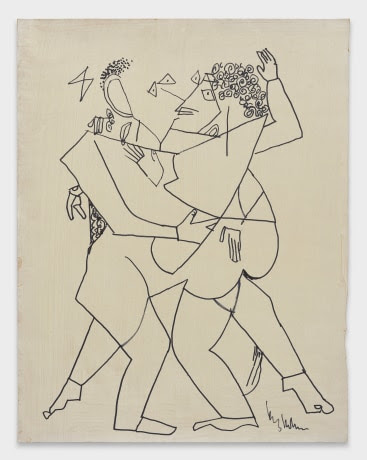
The rhythm of life is the soul of the artistic quest for Mohinder K Puri - better known as M.K.Puri to his colleagues. With a deep emotional attachment to music, dance, and theater, the positive values in life get transformed into lines on paper or with colors on canvas. Happenings and mishappenings keep coming in life but none of them becomes a hurdle in the life of an artist. Facing partition at the tender age of nine and other odd situations, his love for life to strife was never affected and like a vagabond living on the Old Delhi railway station platform, to Howrah bridge in Calcutta and with brothers and sisters he kept moving and singing to harmonize the odds. Art came to him as a happy surprise a little late, which he confronted for the first time in class eight at Dehra Doon. It gave him a kind of settled life after moving from Pakistan for a directionless young boy. A new excitement as never before became an urge for him to learn from a guru. Under Late Devi Singh, his first guru at Chitra Kuteer, the momentum for art began. A kind of ‘Ragatmakata’ (music), ‘Layatmakat’ (the rhythm of dance), and a lyrical mood in the relationship always play on his canvas, he explores all mediums and forms in his artistic search, throughout life; and it continues.
 Came to Delhi in 1960 carrying with him his childhood passion for singing from the balcony of his house in Karachi to Dehra Doon, plus what he learned in art from his first guru in painting. He meets table maestro Pandit Chatur Lal at whose behest he started learning music from Pandit Amarnath. How he made it to Pandit Ji & why he could not continue is another story. At the same time, he joined Triveni Kala Sangam under Prof K.S. Kulkarni to start his incomplete passion for art and later joined Delhi Art Collage known as Delhi Polytechnic that time. That was the time that most artists had a great impression of Picasso and Puri was no exception - also inspired by him as well as by his teacher Prof Kulkarni. His painting was first time selected in the annual art exhibition of Lalit Kala Academy in 1964 when still in Art College. 1968 saw his first one-man show in Delhi. His large painting ‘Composition 1947’ on the pains of partition brought him laurels. Great art critic Dr. Charles Fabri compared him with Picasso in his write-up. In art, things going smoothly perhaps is a misquote, as there is always something missing in one’s art that keeps questioning the inner self quietly. Acceptance of the art world is a good sign and to be satisfied is another. It is perhaps necessary to have one’s own identity and space.


 He shifted his creative adventure and starts ceramics under the guidance of Guruchran Singh – father of studio pottery and Mansimran Singh, his son. This adventure gave him an opening to make ceramic murals for the interiors and exteriors of buildings. This was another turning point, and he expanded mural-making in other mediums too. A very large high-relief mural, with looking glass of various shades and colors for the Himachal Pavilion at Pragati Maidan in Delhi, was a landmark. Simultaneously, the urge to explore round sculpture in ceramic opened a new chapter in the field of sculpture in India and his life, Late Krishnan Chaitanya particularly stated this in his column in The Statesman. He did lots of experiments with clay and firing and created his own identity in sculpture. Being the first one in the country, especially with his head, got warm responses from artists and art lovers. Balbir Singh Katt was very fond of his ceramic heads and would encourage him to exhibit them at other places.


 Once again the time for change was now visible in his new paintings. During the ‘no painting ‘ period, drawings became his forte as a medium of expression and which he exclusively exhibited in different places. At this juncture, the use of waterproof ink on paper as a painting medium gave his paintings a new texture in terms of surface treatment but equally expression as a major component, which essentially added to the thought process that a creative process he now opens. Keshav Malik wrote on his drawings ‘the secret of the new, crisp ink-work is drawing, in itself of a ceramic firmness. He realizes that the music and dance; the rhythm of life in music, were the relationship of the soul of his artistic quest. After that, he never turned back and became an important artist of our time. He says that Pandit Ravishankar’s sitar playing, Chaturlal’s tabla playing, and the dance of Biraju Maharaj added new aesthetics to his art. His set designs for the famous ballet ‘Katha Raghunath Ki’ and Krishnayan’ both choreographed by great kathak exponent of the country Shree Birju Maharaj, was well received as an original and impressive attempt in set designing. Two years with Birju Maharaj gave him an intense understanding of the importance of expression and also. His involvement in the theatre workshop- acting in the play ‘Mother’ by Brecht under well-known theatre director-actor M.K. Raina, enlarged his understanding of human situations in life. With Puri’s engagement with the figurative figments with the inner, dramatic self perhaps emerged from here. His ‘masks’- an extension of ceramic heads, while they are individually striking and his drawings brought a richer, more structured meaning. The ‘Dialogue’ series recreates for us the nuances of the human situation. Many of these works use the usual devices of distortion; montage, break up of space (or flesh back, as in films) meaningful.’


 He creates a piece of silent music on canvas through the colors and textures, and rhythm of the dance in lines. In his paintings, figures emerge as realistic and then slowly-slowly convert into an abstract form or semi-abstract form, more an embodiment of expression. The emphasis on expressions is synonymous with the abstraction of mental attitude, affecting his human figures sometimes; and sometimes, the reflection of a human body gives a new dimension to the painting. It all happened due to his deep love for innovative Indian music. He says “I have always been a musician in my heart and soul. Music provides me nectar of creativity. It has such a vast magnetic field. As a matter of fact, I could have been a musician rather than a painter making a painting on music. For years I have gone to Indian classical music concerts. Listing to great Indian masters was an experience in itself and still provides me with enough food for creativity. ….. . I, therefore, paint a musician with a multi-faced deeply absorbed expression in time-space multidimensional planes. This is only possible when the music itself became part of the self.”


 His human forms give a feeling of sculptures, maybe the reason is that he creates a lot of ceramic sculptures; and it adds another aspect to his paintings, a kind of theatrical feeling. He works for theater many times as a stage designer, which helps to portray the dramatic situation of human life, as well as get command of space division. He arranges forms with a dramatic effect. The human drama played on his canvas, whiteout sound. Dramatic situations in human society, collectively or individual relations, became satirical for some time, but mostly they give a lyrical and rhythmic direction to life which is the main concern to M.K.Puri.


 Apart from that music and dance, he explores human conditions in different situations. In 2010 he did a solo exhibition ‘BANDISHEN’, in which he exhibited works devoted to music, but the rest of his creation is the representational act of human feelings and their sheer presence in the space. For example, we can see his painting ‘Horse Story’ or ‘Chess Game’ that represent contradictory situations in life. He also portrays the conflicts of inner and outer personality through the mask on faces. Human relationships, love and hate, dialogue and silence, anxiety, surprise, loss, and win, all of them part of life emerges on his canvases, sometimes with low volume and sometimes with high volume.