triveni kala sangam लेबलों वाले संदेश दिखाए जा रहे हैं. सभी संदेश दिखाएं

सोमवार, 10 अप्रैल 2023

K S Kulkarni modern master of Indian art

Ved Prakash Bhardwaj Krishna Shamrao Kulkarni (7 April 1916 – 7 October 1994), commonly known as KS Kulkarni, was a modern Indian painter and teacher. He developed his pictorial language by combining Indian painting tradition and modern European style. His work was part of the painting event in the art competition at the 1948 Summer Olympics. He was the founder-president of Delhi Shilpi Chakra and one of the founders of Triveni Kala Sangam. His ideas, technical skills, and teaching have influenced the work of many contemporary painters.
Kulkarni was born in Belgaum, Karnataka. Due to his interest in painting since childhood, he wanted to study art at the Bombay School, but due to the untimely death of his father, he had to postpone his dream for some time. In the early 1930s, at the age of just 14, he worked as a signboard and cinema poster artist. At the same time, he moved to Mumbai where he did his Diploma in Painting from Sir JJ School of Art in 1940 while working. In the year 1942, he completed a two-year post-graduate course in mural painting from the same institute. He received a research scholarship from the Tata Trust from 1941 to 1943 to study Indian painting. Kulkarni was also associated with the Quit India Movement in 1942.
After completing their education, he started working as a designer in a textile mill in Delhi. Despite not having an education in textile design, he did that work successfully. Due to transfers and other pressures, he left this job in 1945. He started feeling that he was not able to bring out the artist inside him while working as a designer. He decided to establish himself as a teacher and joined the Arts department of Delhi Polytechnic. Shortly thereafter, in 1949, he founded the Delhi Shilpi Chakra, a group of young progressive artists in those days. Similarly, he played a major role in the establishment of Triveni Kala Sangam where he was a teacher for many years. In 1962, Kulkarni was elected to the General Council of the Lalit Kala Akademi. He received the National Award in 1955, 1962, and 1965.
Throughout his life, Kulkarni made several foreign trips. In 1949 he became the first Indian artist to participate in the International Art Show organized by the Rockefeller Foundation in the US. Apart from this, he traveled to Mexico, Guatemala, Peru, and Brazil and studied art there. He was also invited as a guest artist by the governments of the USA, USSR, Germany, Poland, Mexico, South Korea, Netherlands, and the UK.
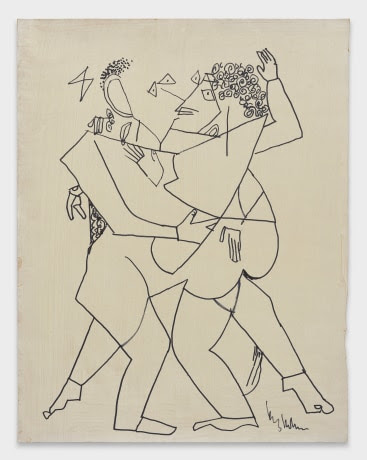
KS Kulkarni's art was multidimensional. He also did sculpture along with painting. He worked in many mediums and styles. Along with the creation of figurative paintings in the cubist style, he also created abstract paintings. His pen and ink drawings have been popular. He worked in oil and acrylic paintings, and sculptures in terracotta, wood as well as ceramics. Kulkarni never tied himself to any particular genre or medium. He wanted freedom as an artist and encouraged his students to do the same.
In his depiction of human figures, the Ajanta frescoes, the Chola bronze sculptures as well as the touch of modernism are found. In his later works, the stylistic influence of Pablo Picasso's Cubism is clearly visible. His later works show the tremendous influence of Picasso. But in that too he merged traditional Indian folk and tribal art forms. In the catalog of Kulkarni's exhibition at Delhi's Dhumimal Art Gallery, J. Swaminathan wrote that he was a brilliant draftsman as well as a master colorist. In 1979, Kulkarni became partially blind and for some time lost the ability to recognize people. He convinced a doctor in Texas to perform delicate eye surgery in exchange for paintings. Even though the surgery was successful, a cataract continued to hinder his vision, making it difficult for him to work. He died on 7 October 1994.

गुरुवार, 6 अप्रैल 2023

The flow of life in nature, Solo Exhibition of Shampa Sircar Das

Ved Prakash Bhardwaj
Shampa Sircar Das's solo exhibition titled Pravah, curated by Anu Bajaj, opens at Sridharani Art Gallery, Delhi on 4th April. This exhibition can be seen till April 14. The exhibition is organized by Gallery Art Positive. It includes paintings as well as some sculptures of Shampa. Shampa has been identified as an artist who portrays spiritual experiences and natural beauty. The aesthetic side of his art is so strong that the ideological light behind it gets hidden. Shampa's art is also a search for the meaning of nature and the presence of all living beings including humans in it. It also indicates how our relationship with nature is and how it should be. This exhibition is an expression of the flow of life in nature.
If you look at the pictures included in this exhibition, along with humans, deer, elephants, lions, peacocks, fish, birds are all part of a beautiful natural environment. This is an indication that nature attains perfection only with all living beings, on the other hand all living beings can also exist only under the shelter of nature. Here the artist has not given any kind of direct message, indirectly there is a big message in these pictures. The ill-effects of the manner in which man has mindlessly destroyed nature for his selfishness have come to the fore. Today the whole world is talking about environmental crisis, talking about the balance of life with nature. This is what Shampa says through her art.
To give a simplistic interpretation of Shampa's art would be unfair to him. If we are limited only to the natural beauty, to the brightness of the colours, then we will not be able to understand these paintings in their entirety. Shampa and her husband Sanjay Das, a creative photographer, travel a lot. Sanjay captures such scenes with his camera which demand wider social discussion. What Sanjay does with the camera, Shampa does with colors on the canvas. The Buddhist monasteries and Thanka paintings of Leh-Ladakh not only influenced her work, but also gave him a different direction. On one hand the experiences of Ladakh take shape in Shampa's paintings, on the other hand the life struggle of women from Bihar, Bengal and other places gives him the power to think of painting differently. She does not take women's struggle as a slogan but takes it as a creative side of life. Shampa's childhood was spent in Delhi exposed to Bengali culture, as well as her schooling influenced by Sri Aurobindo's philosophy which she still believes in today. After doing MFA, Shampa had to keep himself away from art due to family reasons. There was a long struggle in life and he kept distance from art for about seven years. In 2002, Shampa turned to art again and started a new life with canvas. She was not able to satisfy herself even after participating in group exhibitions. Then in 2003 she went to Leh and Ladakh with Sanjay. The natural beauty of the mountains and the spiritual atmosphere of Buddhist monasteries as well as thanka paintings inspired him. Returning from there in 2003, she did an exhibition titled Tatva. After that, this process continued for the next three years. The golden color of thanka paintings and Buddhist monasteries, the gray and white colors of mountains and the red color of spiritual energy became prominent on her canvas. We also find images of words written on the walls of monasteries in the paintings of that time.
If you look at the paintings included in this exhibition, many images of Buddhist monasteries and Thanka paintings have been used in them. Apart from this, figures like meditating monk and nun are also here. The presence of deer in these paintings has a special significance. Deer are considered to be very beautiful yet gullible creatures, just like nature. She also uses the lotus flower to reveal the beautiful and soft element of nature. The frequency of blue color in these paintings gives a sense of the purity of water and sky. Golden and red colors are still dear to Shampa. With metallic colors, she creates a new aura in the picture. Her painting process is different. She creates texture by first applying two-three layers of colors on the canvas. After that she starts creating shapes on it. In this way, many colors together become like a musical tune.