मंगलवार, 6 जून 2023

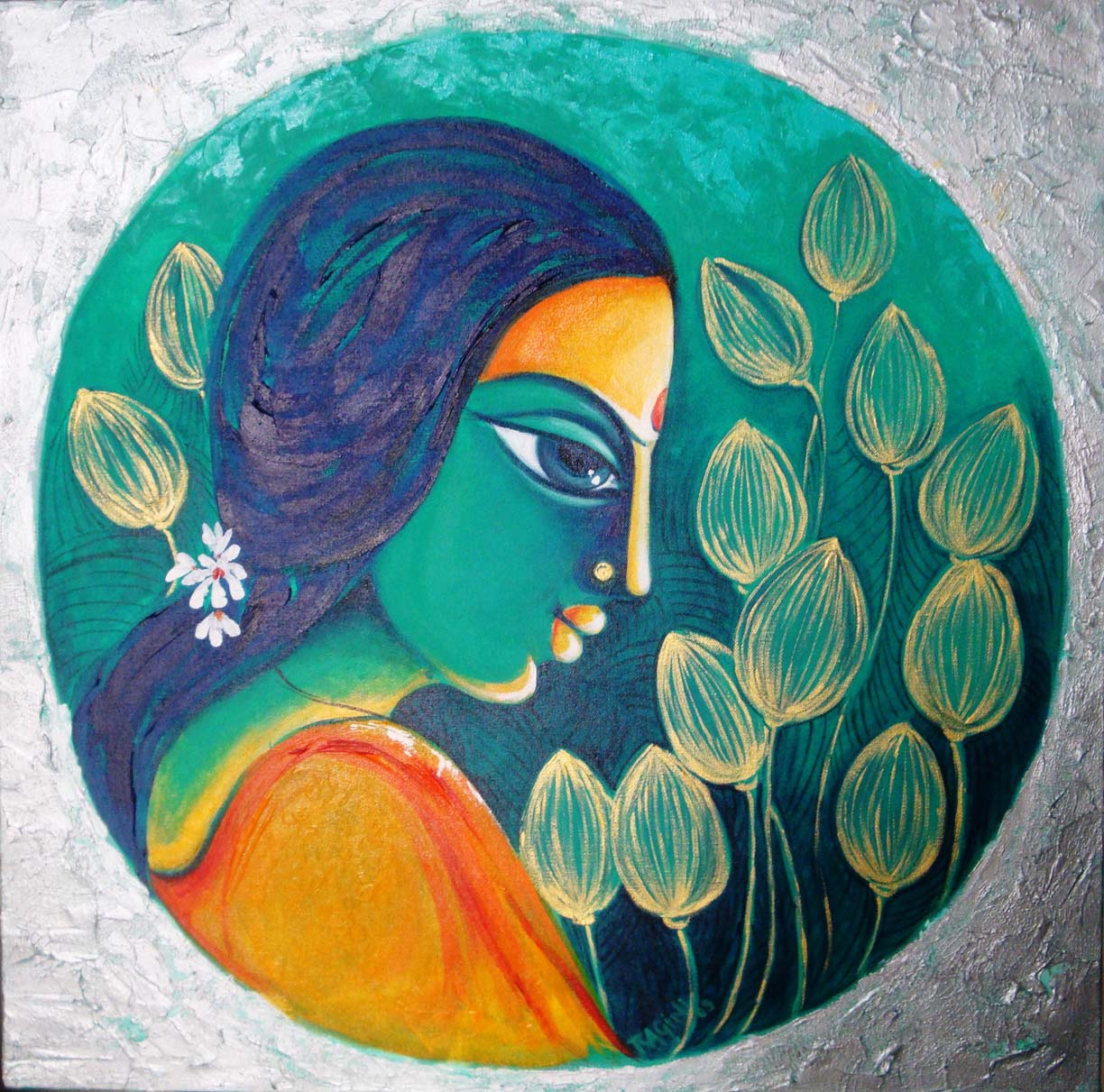
Ragini Sinha: expression of human aspirations and freedom by Ved Prakash Bhardwa

As an artist, I have come to love freedom – freedom of which the kite is a dynamic symbol in my creation. -Ragini Sinha
As an artist, we learn a lot from our environment and take many inspirations from it, but it is rare that an artist continuously transforms seemingly ordinary things from his environment into an all-time multidimensional expression of life. Ragini Sinha is one artist who has always turned an ordinary experience into an extraordinary one. Through symbols, he has presented a different perspective of looking at life in his art. That's why in his paintings, the simple-looking mushroom becomes a symbol of the birth of hope, while the kite becomes an expression of human aspirations and freedom. Starting her journey from a small town in Bihar, India, Ragini Sinha is today a well-known name in the contemporary art world of the country. When I ask her why she chose 'mushroom' as a motif, she explains that she finds a mystery in it. The quest to understand the mystery and reality of life inspired him to explore new expressions in art.
He has always welcomed new challenges in his artistic journey. He never hesitated to adopt new subjects as well as new mediums, insted he has been getting a different kind of thrill about new mediums. She says that when she was studying in college, most of the girls were not particularly interested in graphic arts. Painting is easier than doing graphics, but it has a different kind of beauty. I started doing graphics (print making) in college. The texture quality in the graphics as well as working with different hues in the same color was a challenge. I accepted this challenge. At that time I did a lot of work in graphics, but after coming to Delhi, I left it because I did not have the facility to do graphics here. Ragini Sinha stopped doing graphics after coming to Delhi but she started bringing the texture quality of graphics to her paintings. As a result of this, a new dimension started appearing in his paintings. Along with the original subject, he started adjusting the texture in the background in such a way that a new aura was added to the painting. She breaks the flatness in the picture and takes it to multi-meaning images.
His paintings are emotionally powerful. Whether he paints mushrooms or kites, or images of women, they all aim at the expression of feelings and emotions. She portrays the most beautiful aspects of human life to add something beautiful to the lives of those who see her art. After coming to Delhi, there was a different world in front of Ragini Sinha, the crowd all around, and the odd condition of the woman in that crowd. The condition of women in a modern and educated society was worse than that of an uneducated society. She picks up the brush and starts a new series focusing on women's lives. Even in the worst condition of a woman, which is her powerful side, to save and decorate life, to give it a new light with feelings and emotions, Ragini starts taking it in her pictures. The canvas of his canvas starts expanding and birds, flowers, leaves, etc. start appearing in it. Instead of being descriptive, she starts saying her point in a more effective way in a symbolic form. From here comes a new twist in his art, to create a new sense of life on the level of art. She has been giving importance to positivity in her art since the beginning, which has now become more vocal.
This positive outlook helps him enter a new world of thought and creation, which is reflected in his Udaan series of paintings. Flying like a kite freedom and passion started touching the new sky of expressions on his canvas.
When we fly a kite in the sky, we feel free in the same way, we enjoy its rhythmic movement; We feel like a bird and feel that we touch the sky. We understand that not all feelings and fantasies are true, but that feelings and fantasies make life enjoyable. Ragini wants to touch new heights of creation but the human form is not enough for her. She then chooses a different form which is flying in the boundless sky, a canvas for Ragini also a sky where she wants to fly with her fantasies and desires. Kite can fly in the sky but it is controlled by hands through a thread. Ragini has a great command over technique and knows very well how to fly her painting like a kite. The compassion, the color scheme, and use of negative and positive space, and the use of texture reflect his quality. Another turning point I would like to highlight in her art is that she blends traditional art with modernity. She uses certain motifs and designs of folk art in some of the paintings. She hails from a state that has a great tradition of folk art, which enriches her creations.
Another new dimension was added to his art when he started making the tradition of Madhubani and Mithila painting a part of contemporary art. The use of motifs and patterns of folk art is visible in many of his recent paintings. This is not just a method of decorating the picture but an initiative to save and carry forward our tradition. She believes that we can get true Indian art only by the coordination of folk and modern art.

Nawal Kishor: emotions that Live on Canvas by Ved Prakash Bhardwaj

What we produce in art should be a pure fusion of sensation and reason, a reasoned emotion. It should be reasonable wisdom. I don't believe it is feasible without initially putting emotional interest first, and there's no doubt that Nawal Kishor’s art is primarily driven by emotion.
In his paintings and drawings, he creates the emotional side of various situations of life as an observer as if he is involved in them. We consider the picture as an artificial expression of the real world, in which the artist has planted feelings. Naval uses such a color scheme for this, which communicates positive energy toward life in the viewers. That is why he uses red, yellow, blue, and brown colors more here, as well as he combines the negative space in the painting in such a way that it becomes easier for the viewer to focus on the picture and its central subject. Nawal did a lot of wash paintings at the collage time and after that also. It’s no doubt that he has a good command of the wash technique, but he left it, and it is a great loss of Indian art. But on another side, a good thing happened also, and that is that he uses the wash effect in his later creation. Mediums have their limitation; acrylic colors can create transparency but they are not capable to create a wash effect. So Nawal has a choice to use more and more transparency to get a wash effect in paintings, for that he works layer by layer. Even the composition of his early paintings gives a feeling of wash paintings.
He focused on ‘Nayika’ and other subjects in wash paintings but when he starts on canvas, he started to explore the spirituality in life, and for that, he chooses the Buddha, Krishna, and Ganesha. He chooses a different color palette for that, mostly different tones of a single color, or using two colors from one family. He uses both warm and cool colors at that time, but after that, his color palette changed or we can say it become more mature. After exploring spirituality for a long time, he starts to explore other parts of life. He understands that spirituality is the only part of life so he starts to explore other parts of life. He starts to search for every aspect of beauty in life, both social acts and personal relations. All the relations and emotions, that make life possible and beautiful, take a different meaning in his creations.
In the early paintings, he follows the all norms of figurative paintings and creates more and more realistic images. Slowly-slowly he developed his form and gives them a more artistic effect. He gives a little touch of abstraction to the human form but still, they are human forms with perfect anatomy. Sometimes he adds two or more hades to a single body and sometimes attached bodies to show the spirit of life. But that is not the end of his artistic quest; it is beginning, to enter in a new artistic approach. Today, there are many artists how to get inspiration from traditional art, Nawal among them, the difference is that he adopts stylized concepts only. He incorporates two faces in one body and uses human postures in outfits. It’s a regular practice in folk art to paint figures in or on one figure. Nawal studied that carefully and use this technique in a modern way. He stylizes it not only as decorative cloths but a stylized expression also, which makes his art more effective. He learns that from his ‘guru’ well-known artist Neeraj Goswamy. Neeraj is known for his rhythmic form and colors which inspired Nawal very much.
One more thing in his paintings is notable, and that is the texture quality in the background. In each painting, he creates different abstract textures in the background, which gives a pleasant feeling. That abstract quality is also present in his paper works. He did a lot of drawings and paintings on paper. In some of them, he gives an abstract effect to some parts of the human body, even abstractly divided space also. He is in the middle of his artistic journey and makes an identity. He is a promising artist and hopes he breaks her limitations and explores unlimited possibilities of art.

बुधवार, 31 मई 2023

What makes Picasso relevant today by Ved Prakash Bhardwaj

There were many great artists in the twentieth century who gave many new dimensions to art. There are many contemporary and later artists of Pablo Picasso whom we remember today, but Picasso still seems to be the most important and relevant of them all. Understanding what causes this has always been a puzzle. Picasso was the subject of controversy regarding his treatment of fellow artists, his views on women, and many other reasons, but this did not detract from his greatness as an artist. This year, when his fiftieth death anniversary year is being celebrated all over the world, his exhibitions are being held at various places, then discussion has started about his being relevant even today. Recently Picasso Museum in Málaga, Spain opens an exhibition of Picasso’s sculptures, ‘Picasso Sculptor: Matter and Body’ showing his sculptures depicting human figures. Málaga is the birthplace of Picasso.  Picasso is best known in the world for his paintings. Among the artists who are credited with introducing cubism, Picasso appears to be at the forefront. His painting Guernica is still considered one of the most powerful symbols of resistance to war and violence. His sketch of a peace dove is an indelible symbol of human history. The sculpture of a bull made from the seat and handle of a bicycle is said to be a departure of art from waste material. There are so many things that keep Picasso relevant even today.
It was not only Picasso who did this, he did graphics with painting, made sculptures, and worked in many other mediums. Many of his contemporaries were doing the same. Picasso once said, "Good artists borrow, great artists steal." Picasso was a good artist in that he did not hesitate to borrow from wherever he found something useful and meaningful. At the beginning of cubism, he borrowed heavily from his fellow artist Georges Braque. Before that, he took the concept of cubism from Paul Cézanne. He took inspiration from African crafts. He also accepted all these things. When he decided to do graphics, he collaborated with other artists. Similarly, to make sculptures, he started creating iron crafts together with Julio González. His fellow cubist artist Georges Braque created sculptures as well as paintings. John Miró was a painter but he also created sculptures. Thus there were many artists who at that time were working in other genres after being established as painters. So it was not surprising for Picasso to do so. Surprisingly, Picasso made sculpture his main art form like painting. Not that he gave up after making a few sculptures, or made only occasional sculptures, as many of his contemporaries did. Picasso not only kept sculpture as his main art but made such experiments in it that became an inspiration for the next generation of artists.
There have been many great sculptors before Picasso and even after him, but hardly any of them has done so many inventive works in sculpture. Picasso did more experiments in sculptures than he did in painting. He first worked on found objects. He worked in 1912 with cardboard, wire, etc. When Marcel Duchamp started presenting the readymade object as an art piece, Picasso did not lag in taking inspiration from him and he created a craft with the seat and handlebar of a bicycle. Although this statue of Picasso is kept in the category of a found object, it was a statue made of readymade objects. But one interesting thing about this is that we can also call it the initial form of installation.
Picasso started making sculptures as early as 1909 when he made Woman's Head in bronze. One of the earliest works to re-frame sculpture as an assembly of open, planar parts and something more akin to architecture was Maquette for Guitar which was created in 1912. This piece is made of cardboard, paper, string, and wire that has been folded, threaded, and adhered together to form an assemblage or three-dimensional collage. It was the first sculpture ever made from various parts, and it was unlike any other sculpture that had ever been seen. This work translates Picasso's Cubist ideas in numerous viewpoints and geometric forms into a three-dimensional object, further blurring the line between high art and culture by fluidly combining mass and its surrounding emptiness. Picasso remade this artwork in 1914, this time using sheet metal, which is more stable and long-lasting. 
This was the period when Picasso was in the news for his analytical cubist paintings. Look at his Woman Head sculpture which is also in cubist style and also Maquette for Guitar. This clearly shows that he was creating his painting and sculpture as two expressions of his style. It was not that his crafts appeared to be different from his paintings. The guitar also appears in his cubist paintings. Picasso created sculptures in a variety of materials. For him, expression was more important than content. Yes, later he cast his sculptures made in cardboard or made in cement and ceramic in bronze. Together with Julio González, he started iron sculpture. These crafts created by bending and welding iron rods inspired later artists. Today many artists are doing this kind of work. At that time a critic called these sculptures drawings in space. Picasso later transformed many of his drawings and paintings into sculptures. This inspired many artists.

शनिवार, 27 मई 2023

Sajal Patra: Art as a spiritual journey by Ved Prakash Bhardwaj

Ved Prakash Bhardwaj Senior artist Sajal Patra's solo exhibition opens on 15th May 2023 at Jehangir Art Gallery in Mumbai. The exhibition depicts the journey of an artist from a physical state to a spiritual state. The arts are not only the expression of the self but also the search for the self. Our position in this universe is in the form of a particle that makes life possible by meeting other particles. This lowliness of life inspires an artist to attain the highest status. This highest state is the realization of the Self. This attainment of self is the act of reaching man to the creator who has created this world. It is a spiritual process in which every artist is knowingly or unknowingly involved. Senior artist Sajal Patra's art also establishes a dialogue with the supreme power while searching for the self. In his paintings, we can see that a human figure remains animate. That shape appears to move from one position to another. Stability is not the quality of his paintings.
Looking at the arts as a means to connect with the divine gives us a sense of our place and role in the world God has created. In this role, apart from performing worldly activities, we also aim to know and reach that supreme power. The arts help us in this work. Sajal Patra creates his paintings with this feeling. There is no one form of Atman i.e. Divine, the form is only of the human body, rising above which is spirituality. A yogi does penance for it, and a painter creates pictures for it. In both the physical condition i.e. the attainment of the self after being freed from the body is the ultimate, that is why we see that in Sajal Patra's paintings, the human form moves from realistic to abstraction as if the body is merging into the soul.
In spirituality, our emotions, desires, and inner activities are channeled in a direction in which we recognize our relationship with God as well as with ourselves and others. It is only after this recognition that man is able to realize liberation. In art, an artist dissolves himself in his art, so much so that he and his work become one. There is no difference between the two. We can know this by looking at Sajal Patra's personality and his art together.
Art fills its creator as well as the beholder with a sense of peace, but at the same time makes him restless about the question of his position and purpose in life. Engaging with art leads us to a state where we begin to understand our relationship with God. This is our situation when we look at the paintings of Sajal Patra.