

Dr. Ved Prakash Bhardwaj
A question has often been raised about abstract art:
What exactly is it? Is abstraction in the shape, in the use of colours, or is it
abstract only because it lacks recognizable form? Is it something born in the
artist's mind while creating it, or does it arise in the mind of the viewer
while observing it? Or is it a purely conceptual process? Art in India has
existed in many forms for centuries, yet its theoretical framework has been less
developed, which is why we lack a comprehensive written history. Consequently,
abstract art is often seen as a discovery of the Western art world. However,
India has long been home to abstract forms—the Shivalinga being one of the
oldest, and the imagination of Brahma also being abstract. Nirgunopasana, a
spiritual stream from the Bhakti period in Hindi literature, too, embodies
abstraction. Despite this, when we speak of abstract art in painting, we often
look to Western examples.

V.S, Gaitonde
For a long time in India, modern art was synonymous
with abstract art, a perception that still persists to some extent. Perhaps this
is because we have not approached our tribal and folk art traditions through an
artistic lens. If we had, we would have seen that we, too, possess a deep
tradition of abstraction, and we need not look West for its inspiration. Many
Indian artists—S.H. Raza, G.R. Santosh, K.V. Haridasan, Biren De, J.
Swaminathan, Ramkumar, Manu Parekh, R.M. Palaniappan, Ambadas, and Sadanand
Bakre, along with Nasreen Mohammadi, Shobha Broota—have demonstrated this
through their dedicated practices. Abstraction also lies at the core of the work
of many modern Indian craftsmen. In India, the stream of abstraction flows
naturally in cultural, literary, and spiritual contexts, whereas in the West, it
had to be discovered.

Bipin Kumar
In the West, toward the end of the nineteenth century,
some artists began to feel that the figurative tradition of painting restricted
their creative freedom and obstructed the path to artistic infinity. Abstract
art in the West is generally understood as a combination of shapes, colours, and
lines that do not resemble the visible world. The nineteenth century saw major
shifts in technology, science, and philosophy, prompting artists to seek a form
of art distinct from visual reality and established social-intellectual
paradigms. Terms like "humanoid," "subject-less," and "non-representative" are
used interchangeably with abstract art. Before abstraction, art focused on
depicting human figures and nature, presenting recognizable subjects and
replicating the visual world. These works were carefully proportioned, with
meticulous attention to spatial arrangement and lighting, creating an illusion
of reality.

Ambadas
However, movements such as Impressionism and later Expressionism
initiated a new approach to colour, planting the seeds of abstraction. Artists
like Picasso and Braque advanced it through Cubism, while Kandinsky and Jackson
Pollock transformed it into a celebration of colour and form. Figurative art can
be seen as a journey into the external world—a world we consciously perceive.
Abstract art, on the other hand, leads us inward, into realms not directly
accessible but felt emotionally. Hence, it defies containment in any one form.
Abstract art is, at its core, freedom from the bondage of form. Even so,
geometric abstraction, bound by form, cannot be called complete abstraction.
During a discussion with senior painter Jai Zharotia, he remarked that no
painting can exist without abstraction. This highlights the idea that every
painting has an abstract foundation, no matter how realistic it appears.
Therefore, when a painting includes geometric or Tantric references, it may not
qualify as entirely abstract, even if it attempts to dissolve form through
colour blending.
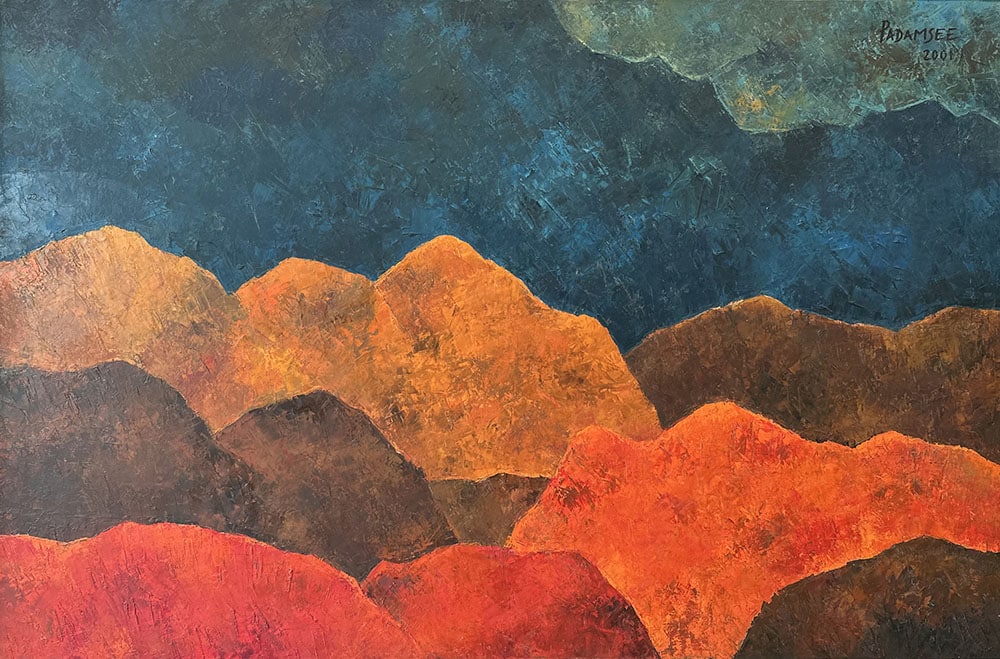
Akbar Padamsee
Complete abstraction is achieved when the painting contains no
identifiable form—only the interplay of colours, leading to formlessness. Few
Indian artists have successfully achieved this. Conversely, many Western
artists—who lacked a traditional framework for abstraction—have made complete
abstraction a possibility. Jackson Pollock, for instance, turned his canvases
into a joyous play of colour, defying verbal explanation. Kandinsky and Mondrian
also created works of complete abstraction, although Kandinsky's later works
included geometric elements. In India, V.S. Gaitonde was perhaps the first
artist to realize complete abstraction in many of his paintings. The layered
application of colour in his work remains a source of inspiration. Gaitonde's
influence extended even to printmaking, and had he lived longer, he might have
furthered abstract art in India. Artists like Manish Pushkale have drawn
inspiration from Gaitonde but developed their own techniques and styles. S.H.
Raza holds a historic position among Indian abstract artists. While known for
geometric forms, his finest abstract works are colour-based compositions,
especially those in his Rajasthan series.

Ram Kumar
Ram Kumar, who began with figurative
painting, later immersed himself in abstraction, becoming a major influence on
younger artists. His abstract representations of Banaras and mountainous
landscapes form a chorus of colours, sometimes clearly referential, sometimes
purely suggestive. Akbar Padamsee is often remembered for his figurative work,
yet his abstract "Metascape" series remains important. Prabhakar Kolte created
his own abstract language after much struggle, influencing many with his flowing
colour techniques. J. Swaminathan integrated tribal art into abstraction, a
legacy continued by his son Harshvardhan. Swaminathan significantly influenced
artists in Madhya Pradesh, including Yusuf and Anwar, both original and
effective voices in abstraction. Gopi Gajwani, known for describing his
paintings as musical compositions of colour, has also achieved complete
abstraction. One must "listen" to his paintings, spending time to feel their
rhythm.

Manu Parekh
Manu Parekh, while not typically identified as an abstract artist due to
his recognizable depictions of Banaras, temples, and boats, infuses his works
with abstract emotion and spirituality—painting not the physical city but its
soul. His "Devi" and "Flower Sutra" series further this abstract spiritual
exploration. Ganesh Haloi has created remarkable abstract watercolours, showing
how minimal means can achieve profound abstraction. Amrit Patel's use of
transparent colour layers lends his work a unique identity, often approaching
complete abstraction. Jeram Patel’s black abstract paintings and later works
with wood, glass, and metal add another distinctive voice.

Amitava Das

Jeram Patel
Amitava Das navigates
both form and formlessness, his early human figures gradually dissolving into
abstract motion. Mona Roy employs diverse materials, pushing abstraction toward
installation art. Shobha Broota has carved out her niche with geometric forms
and explorations of light, recently using thread and wool on canvas. Ambadas,
through his colour compositions, sometimes reveals forms but often achieves
balance and formlessness. Umesh Verma, though influenced by Tantric motifs,
creates abstractions centered around dynamic lines and colour interplay.
.jpg)
P Gopinath
P.
Gopinath, an important figure in South Indian abstraction, remains
under-recognized due to limited exposure. Kalicharan evokes shapes within
abstract structures, reaching complete abstraction. Today, many young Indian
artists are drawn to abstraction. While some lack distinctive direction, many
are finding their voice—among them, Yusuf, Anwar, Akhilesh, Yogendra Tripathi,
Hemraj, Santosh Verma, Satish Sharma, Muralidhar Rai, Dinesh Kumar Ram,
Samindranath Majumdar, Surendra Pal Joshi, Narendrapal Singh, Nupur Kundu, Anis
Niyzi, Ramesh Kher, Ramesh Anand, Saba Hasan, Sujata Bajaj, Alka Lamba, Vikas
Joshi, Seeraj Saxena, and Amit Kalla. As abstract art continues to evolve in
India, it draws upon deep traditions and bold innovations. In future
discussions, we will explore the work of more such artists shaping the
contemporary landscape of Indian abstraction.


